PlanIt Play Curriculum: The Complete Guide for Ages 3–7
PlanIt Play curriculum is a play-based early learning curriculum app for children ages 3–7, built around 9 subjects, 48 weekly themes, and 1,296 activities led by a cast of characters who each anchor one skill at a time. Instead of a stack of worksheets or a grab-bag of activities, it’s a single guided plan: open the app, and that day’s Core learning is already assembled and waiting.
This page walks through exactly what’s in the curriculum — the subjects, the daily structure, the Level 1 to Level 2 progression, and how a real day actually works — so you can see the substance behind it before you decide if it’s right for your child.
How the curriculum is structured
The full curriculum spans two levels across 48 weeks:
- Level 1 (Weeks 1–26): letter sounds, early CVC blending, sight words, foundational number sense, and introductory fine motor and life skills.
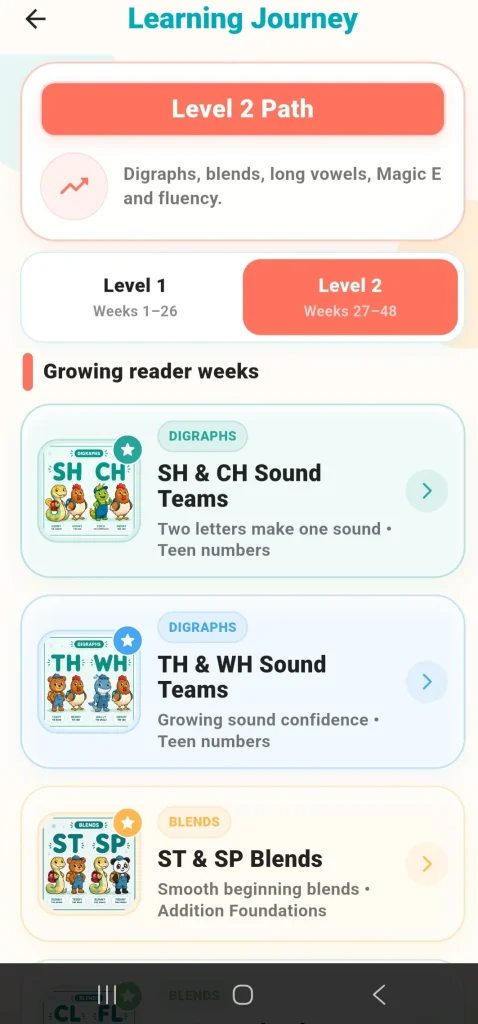
- Level 2 (Weeks 27–48): builds on Level 1 with digraphs, consonant blends, long vowel teams, Magic E, Bossy R sounds, and more advanced maths, writing, and life skills.
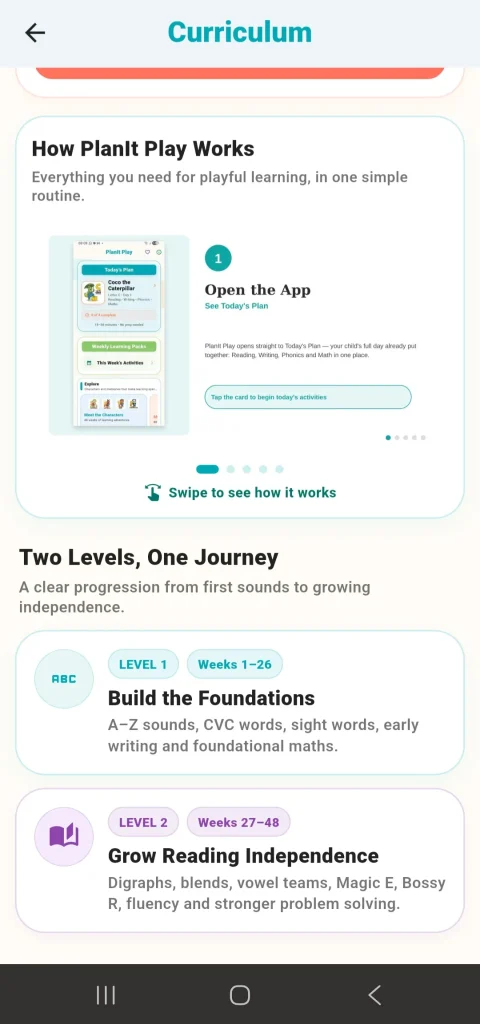
Each week runs across 3 structured learning days and totals 27 activities:
- 12 Core activities a week — 4 Core subjects (Phonics, English Reading, English Writing, Maths) done once each day for 3 days. These are the required learning, tracked right on the day’s card (e.g., “4/4 Core”).
- 15 Explore activities a week — 5 Explore subjects (Fine Motor & Creative Skills, Practical Life Skills, Character Building, Social-Emotional Learning, and Explore, Discover, Move), each appearing 3 times across the week. These are optional extra practice, so a day is genuinely “done” once Core is complete, with Explore there for families who want more.
Across all 48 weeks, that’s 1,296 activities in the full curriculum.
The organizing idea behind all of it is simple: one character, one focus skill, threaded through both the Core and Explore activities for the week. When it’s Sunny the Snake’s week, the /s/ sound doesn’t just show up in the phonics activity — it shows up in that week’s reading, writing, and maths activities too, plus that week’s optional Explore content. The skill gets reinforced from multiple angles instead of practiced once and dropped.
The 9 subjects, explained
Most learning apps built for this age group cover three or four academic subjects and treat everything else as an afterthought. PlanIt Play gives all 9 a defined, structured place in every week — 4 as the required daily Core, 5 as optional Explore practice.
Core subjects (required each learning day):
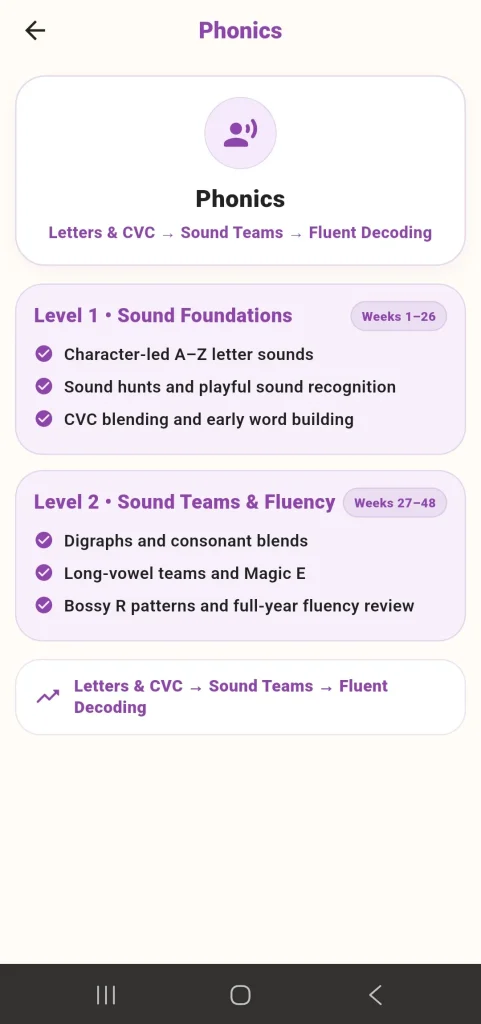
- Phonics (Letters & CVC → Sound Teams → Fluent Decoding) — character-led A–Z letter sounds, sound hunts, and CVC blending in Level 1; digraphs, consonant blends, long-vowel teams, Magic E, and Bossy R patterns in Level 2.
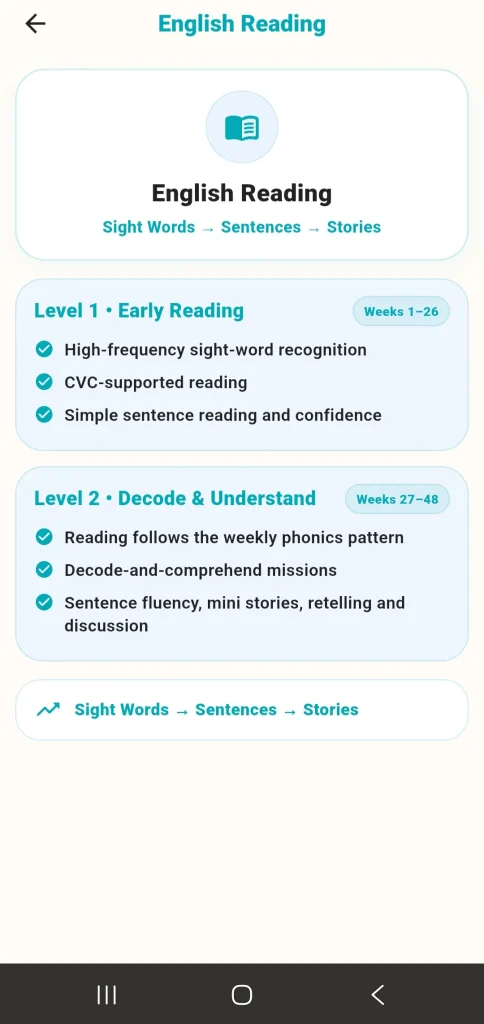
- English Reading (Sight Words → Sentences → Stories) — high-frequency sight-word recognition and CVC-supported reading in Level 1; reading that follows the week’s phonics pattern, decode-and-comprehend missions, and sentence fluency with mini stories in Level 2.
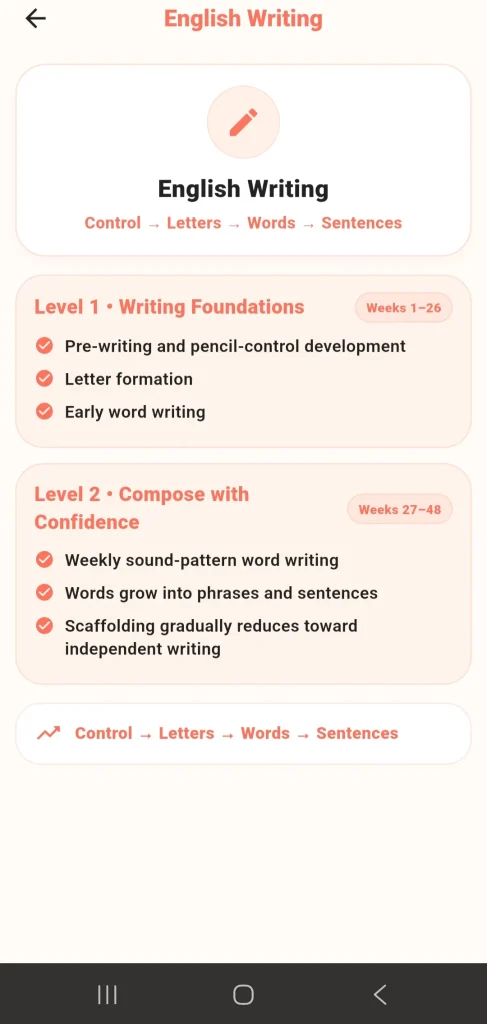
- English Writing (Control → Letters → Words → Sentences) — pre-writing, pencil control, and letter formation in Level 1; weekly sound-pattern word writing that grows into phrases and sentences in Level 2, with scaffolding gradually reducing toward independent writing.
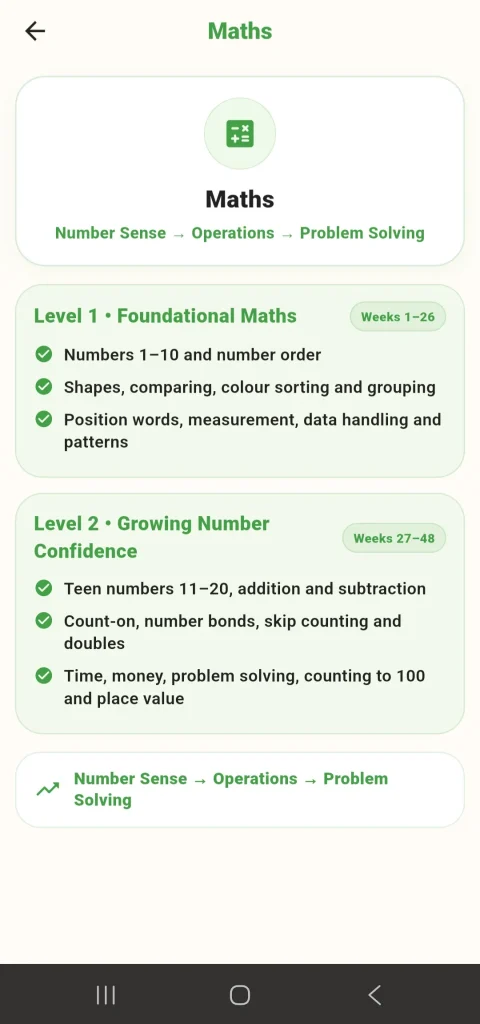
- Maths (Number Sense → Operations → Problem Solving) — numbers 1–10, shapes, comparing, and patterns in Level 1; teen numbers, addition and subtraction, number bonds, time, money, and place value in Level 2.
Explore subjects (optional, for extra practice and screen-free play):
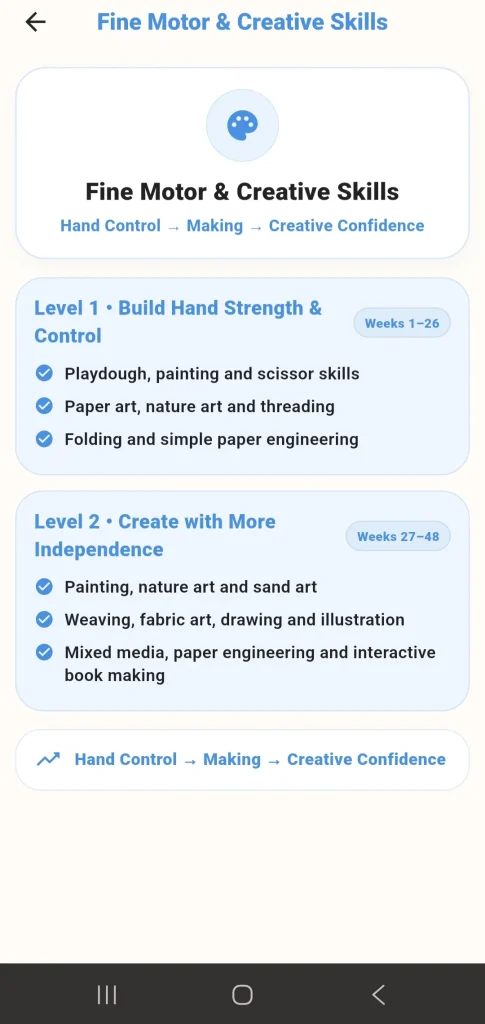
- Fine Motor & Creative Skills (Hand Control → Making → Creative Confidence) — playdough, painting, and scissor skills in Level 1; weaving, fabric art, and paper engineering in Level 2.
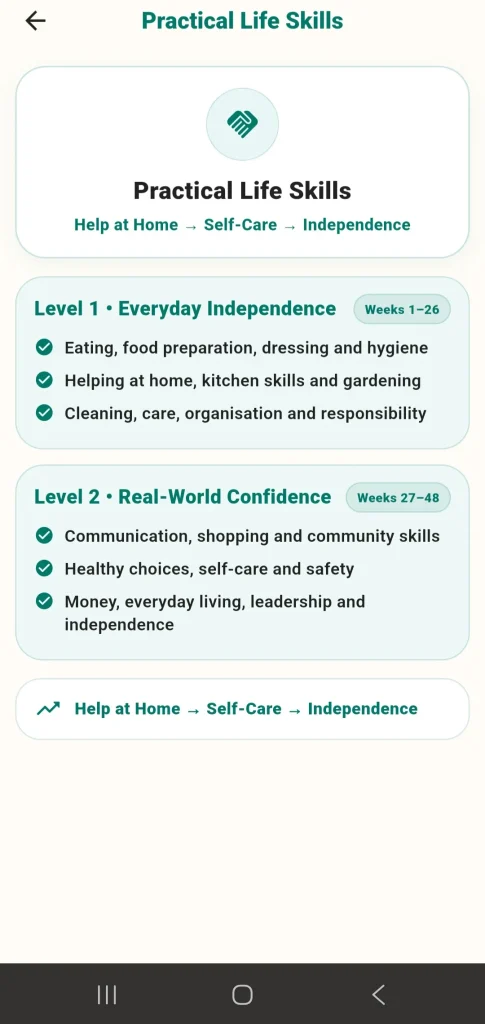
- Practical Life Skills (Help at Home → Self-Care → Independence) — eating, dressing, and hygiene routines in Level 1; shopping, money, and community skills in Level 2.
- Character Building (Values → Choices → Responsibility) — honesty, kindness, and respect in Level 1; citizenship, integrity, and self-discipline in Level 2.
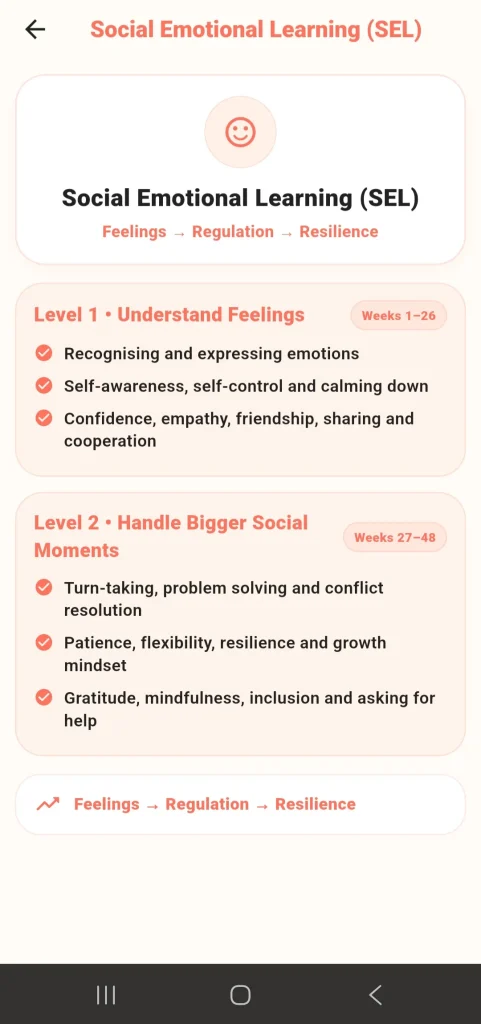
- Social-Emotional Learning (SEL) (Feelings → Regulation → Resilience) — recognising emotions and self-control in Level 1; conflict resolution, resilience, and asking for help in Level 2.
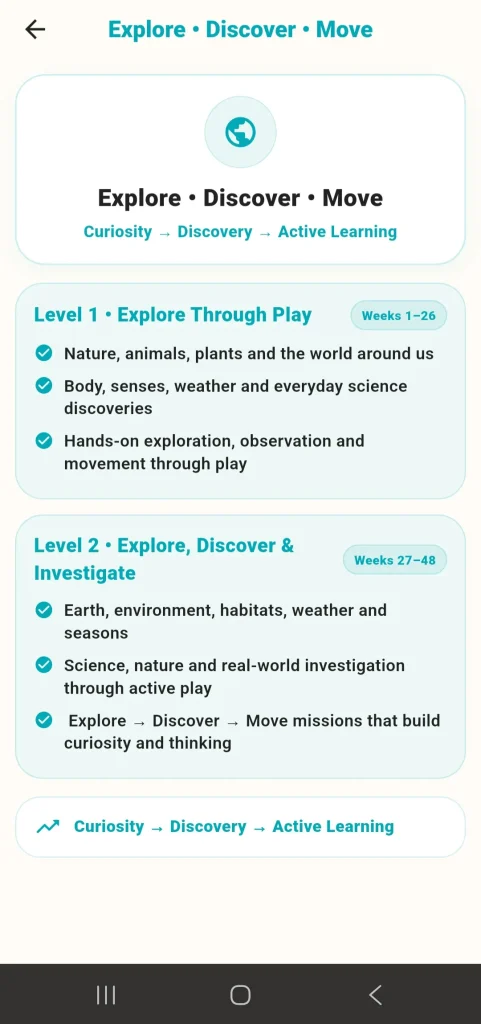
- Explore, Discover, Move (Curiosity → Discovery → Active Learning) — nature, animals, and the senses in Level 1; habitats, weather, and real-world investigation missions in Level 2.
Level 1 vs. Level 2: what changes
| Subject | Level 1 (Weeks 1–26) | Level 2 (Weeks 27–48) |
|---|---|---|
| Phonics | Character-led A–Z letter sounds, sound hunts, CVC blending | Digraphs, consonant blends, long-vowel teams, Magic E, Bossy R, full-year fluency review |
| English Reading | High-frequency sight words, CVC-supported reading, simple sentence reading | Reading follows the weekly phonics pattern, decode-and-comprehend missions, sentence fluency and mini stories |
| English Writing | Pre-writing and pencil control, letter formation, early word writing | Weekly sound-pattern word writing growing into phrases and sentences, scaffolding reduces toward independent writing |
| Maths | Numbers 1–10 and order, shapes and comparing, position words, measurement and patterns | Teen numbers 11–20, addition and subtraction, number bonds and skip counting, time, money, counting to 100, place value |
| Fine Motor & Creative Skills | Playdough, painting and scissor skills, paper and nature art, folding and simple paper engineering | Weaving, fabric art and drawing, mixed media, more advanced paper engineering and interactive book making |
| Practical Life Skills | Eating, dressing and hygiene, helping at home, cleaning and responsibility | Communication, shopping and community skills, healthy choices and safety, money and leadership |
| Character Building | Honesty, kindness, responsibility, courage, fairness and teamwork | Curiosity, creativity, keeping promises, self-discipline, citizenship and integrity |
| Social-Emotional Learning (SEL) | Recognising and expressing emotions, self-control, confidence, empathy and cooperation | Turn-taking, conflict resolution, patience, resilience, gratitude and asking for help |
| Explore, Discover, Move | Nature, animals and the senses, hands-on exploration and movement | Habitats, weather and seasons, real-world investigation missions |
Meet the characters behind the sounds
Every phonics focus in PlanIt Play is taught by a specific character, and that pairing stays consistent — so the association builds over weeks, not just within a single lesson. A few examples from the curriculum:
- Sunny the Snake introduces the /s/ sound in Week 1, then returns in Level 2 alongside Henny the Hen to teach the SH digraph
- Andy the Ant introduces short /a/ in Week 2 and later joins Rory for the AR Bossy R sound team
- Teddy the Bear introduces /t/ in Week 3, then pairs with Henny the Hen for TH, and with Rory for the TR blend
- Coco the Caterpillar and Henny the Hen together teach the CH digraph; Wally the Whale and Henny the Hen teach WH
- Sunny, Teddy, and Penny the Panda combine for the ST and SP consonant blends
- Ellie returns throughout Level 2 to teach Magic E — literally standing at the end of a word to show how a silent letter changes its sound
- Rory joins existing characters across Level 2 for consonant blends (Foxy + Rory for “fr,” Gigi + Rory for “gr”) and the Bossy R sound teams (Andy + Rory for “ar,” Ollie + Rory for “or”)
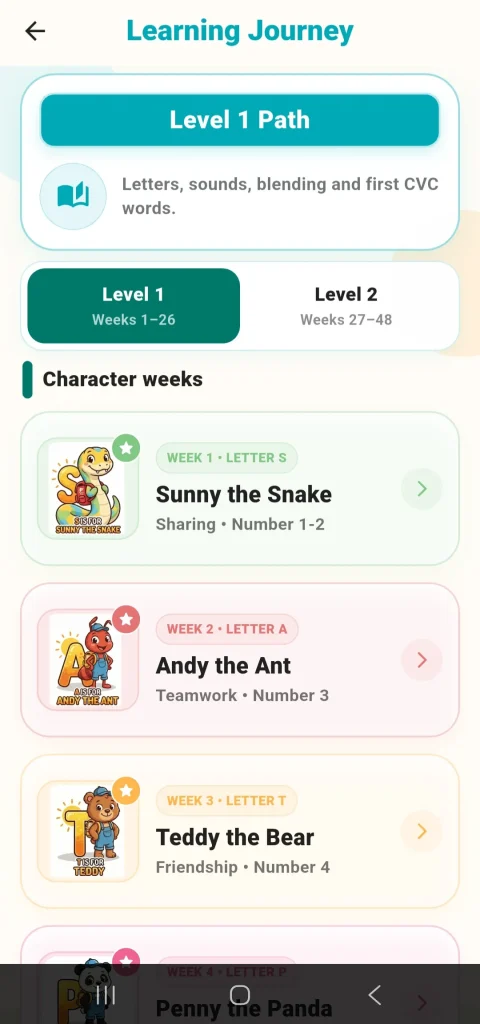
By the time a child reaches Level 2, they’re not meeting a new mascot every week for its own sake — they’re meeting familiar characters again, now teaching a more advanced version of a skill they’ve already started.
What a real learning day looks like
There’s no lesson planning and no printing. Open the app and that day’s plan is already built around one character — for example, “Coco the Caterpillar, Letter C, Day 1” — with the day’s 4 Core activities ready to go and a live count of how many are complete. Once Core is finished, that day’s Explore activities are there as optional extra practice, not one more thing on the to-do list. Each weekly pack also bundles together that week’s Core Pack, Reading Pack, and printable worksheets in one place. A full day takes roughly 15–30 minutes, and this structured version happens 3 days a week.
Who this curriculum is a good fit for
PlanIt Play is built for children ages 3–7 — from a first introduction to letter sounds through early reading fluency and kindergarten-level phonics patterns like Bossy R and long vowel teams. It’s designed for parents who want a structured, open-and-go plan rather than a curriculum they need to build or heavily supplement themselves.
It’s worth being clear about what it isn’t: it’s not a substitute for one-on-one instruction if your child needs specific learning support, and it’s not a guarantee of a particular reading level by a particular age — every child progresses differently. What it does provide is a consistent, whole-child structure so you’re not starting from a blank page each day.
On pricing: PlanIt Play uses a one-time payment model rather than a recurring subscription. Current pricing and any active offers are on [our pricing page] rather than repeated here, so you’re always seeing the up-to-date number.
Frequently asked questions
What ages is the PlanIt Play curriculum designed for? Ages 3 to 7, spanning early phonics and number sense through more advanced reading and maths skills like digraphs, vowel teams, and place value.
How much time does the curriculum take each day? About 15–30 minutes per learning day: 4 required Core activities (Phonics, English Reading, English Writing, Maths) plus optional Explore activities for extra practice. The curriculum runs 3 structured days a week — 27 activities a week in total, or 1,296 across the full 48-week curriculum.
What subjects does PlanIt Play Curriculum cover? Four Core academic subjects — Phonics, English Reading, English Writing, and Maths — plus five Explore subjects: Fine Motor & Creative Skills, Practical Life Skills, Character Building, Social-Emotional Learning, and Explore, Discover, Move. Each week includes 12 Core activities (the 4 Core subjects across 3 days) and 15 Explore activities (the 5 Explore subjects, 3 each).
What’s the difference between Level 1 and Level 2? Level 1 (Weeks 1–26) covers letter sounds, early CVC blending, sight words, and foundational number sense. Level 2 (Weeks 27–48) builds on that with digraphs, consonant blends, long vowel teams, Magic E, Bossy R sounds, and more advanced maths and writing.
Are the Explore activities required? No. Core activities are the required daily learning. Explore activities are optional extra practice for families who want more hands-on or screen-light play.
Do I need to prepare anything before each lesson? No. Each day’s activities and materials are laid out in the app in advance — most activities use items already in the house.
Is there a subscription? No. PlanIt Play is a one-time payment rather than a recurring subscription. See [our pricing page] for current details.